
Transporting Totems
by Laura Murray, July 2026
I must have first gone to the Royal Ontario Museum when I was six, not long after we moved to Toronto. When I go back now, I feel six again, eyes struggling to adjust to the dim interior, overwhelmed by the oppressive echoes of shouting school groups. Just inside the Avenue Road entrance, the stone spiral staircases are still there, framed by polished Corinthian columns. And, looking up, I am still surprised that each massive staircase still turns tightly around a… totem pole? In fact two, back to back. On your left, the tallest pole stands dark and glossy, seeking the skylight and sky above. You can’t even see its top.
You climb. You meet a being with many teeth and enormous eyes. You meet an imposing eagle — maybe with a person in its stomach? — and a monumental human, with a smaller human on its lap. The shiny metal hand rail is very cold but you hold onto it so you can look up without falling down. You meet the figure I remember as a surprised donkey (it is in fact a bullhead fish according to the sign), and a giant winged creature with a crown of human faces (a dragonfly, the sign explains). Almost at the top is a massive fish of some kind. It is a vertiginous experience to look all the way up to the imposing man with a large staff, the glass above barely clearing the bird on his head.
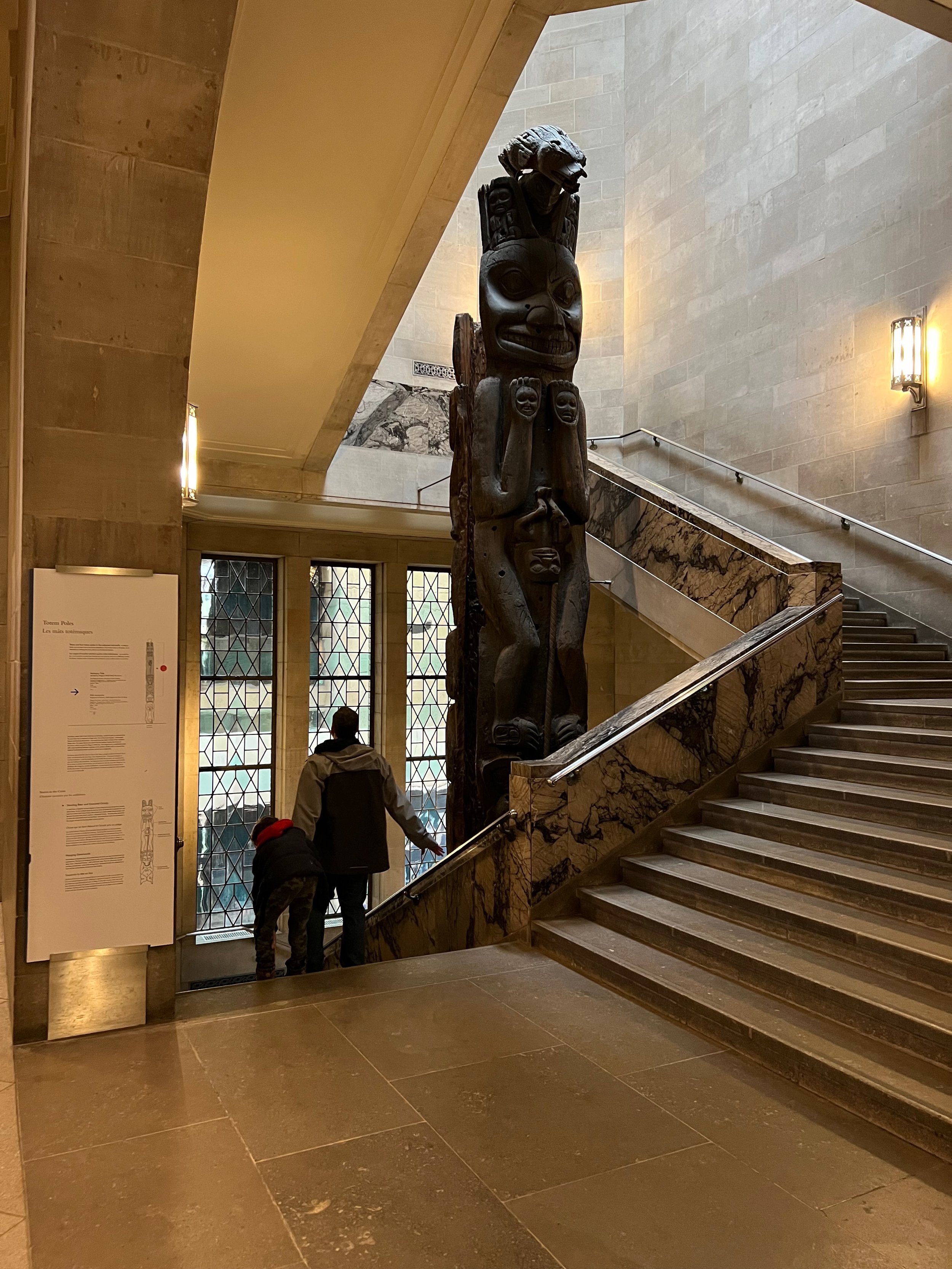
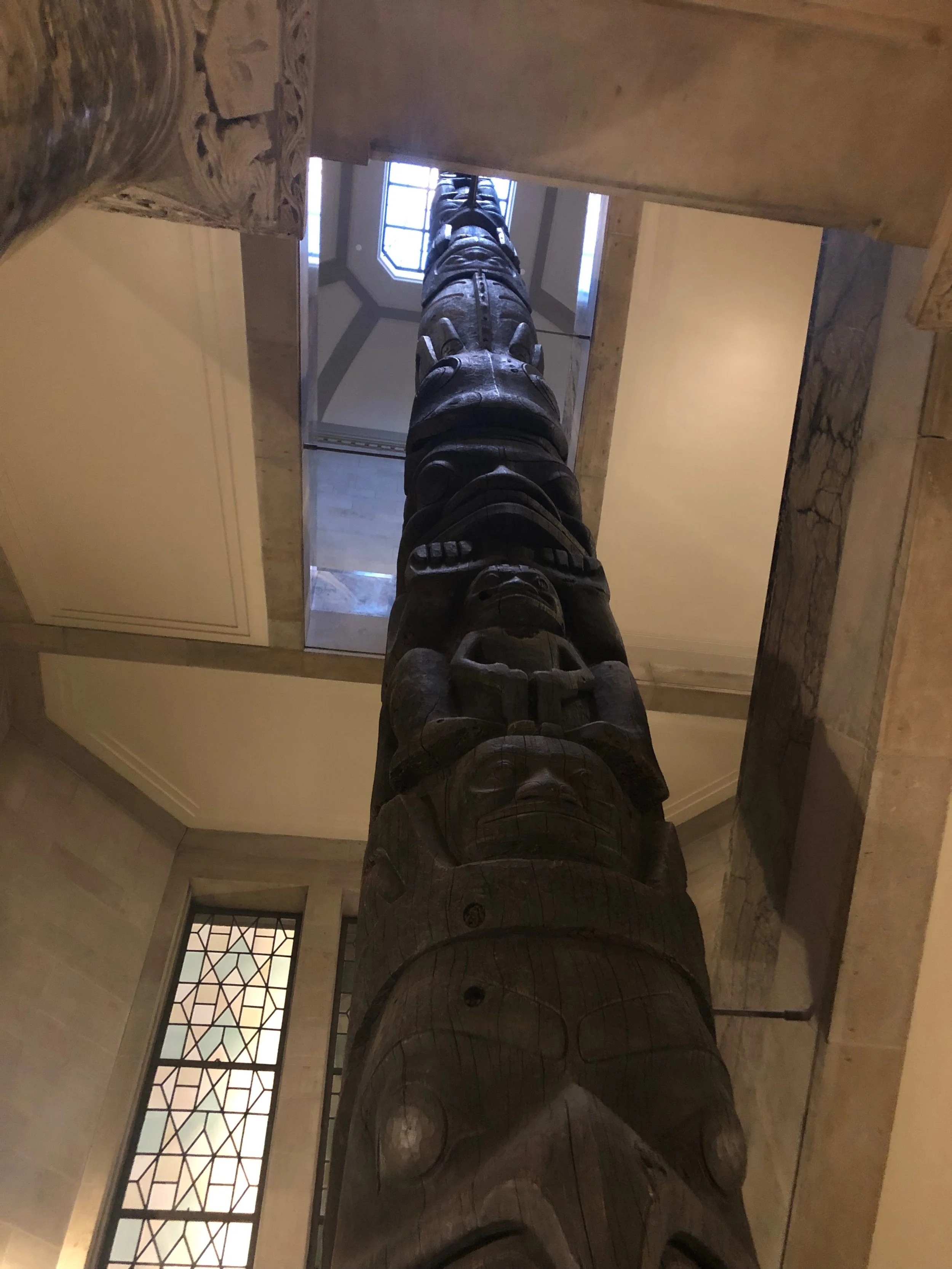
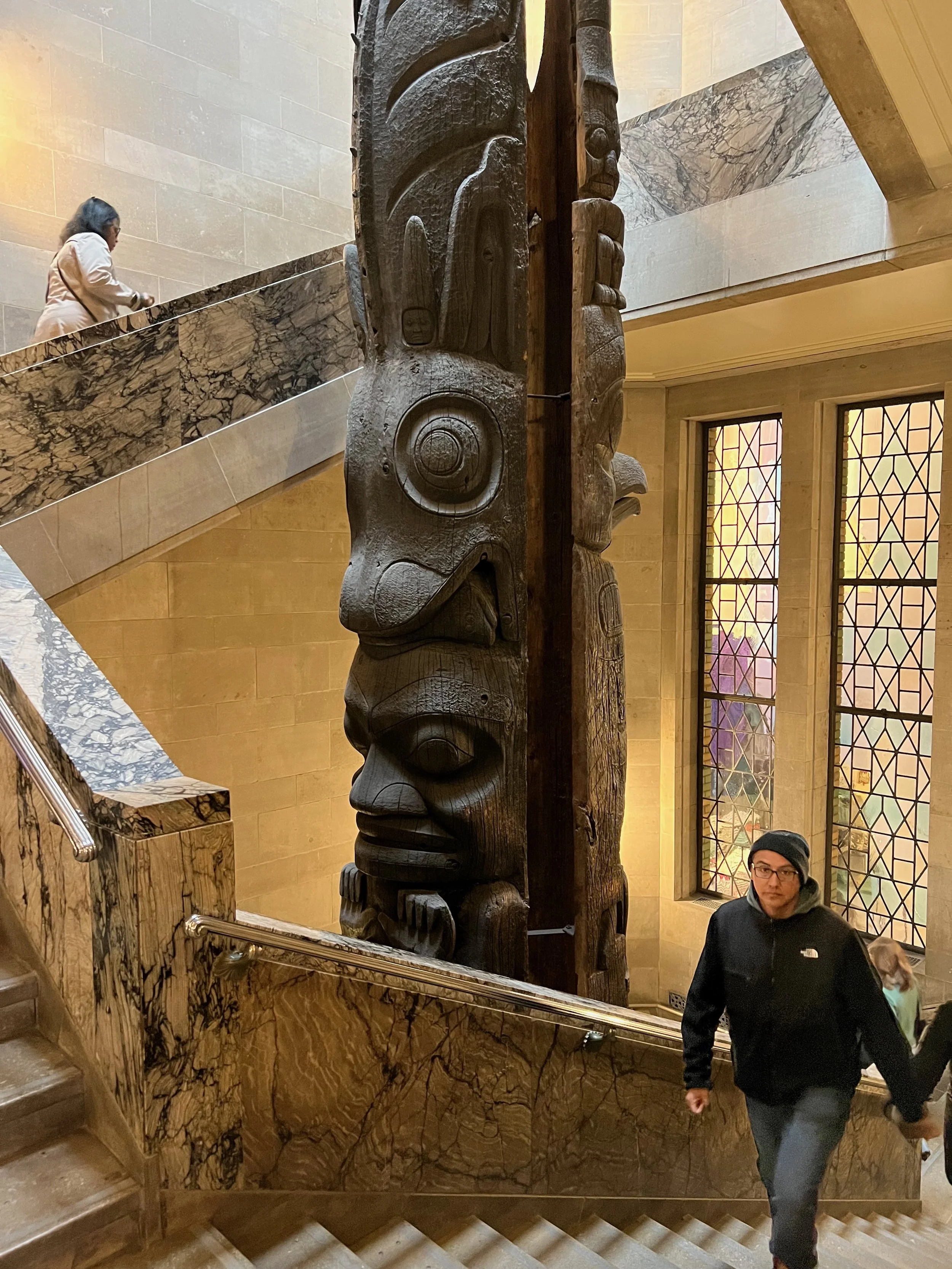
In the din, I overhear a kid’s very good question: how did they get IN here?
In fact, in 1933, the staircases of the new ROM addition were built around the poles, after their journey by boat and train all the way from Nisga’a and Haida territories on the Pacific coast.
Marius Barbeau, the anthropologist who arranged for them to be brought to Toronto, put the poles’ makers in the company of Van Gogh, Cézanne, and Gaugin, who he noted were their contemporaries. At the same time, he stated that “the art of carving poles belongs to the past.” Indeed, carving poles had been confined to the past by the Potlatch Ban (1884-1951), by which ceremonies serving essential community and political functions, including the raising of totem poles, were prohibited under the Indian Act. With West Coast Indigenous cultural production both celebrated and forbidden, poles from British Columbia were deemed worthy of rescue and suitable to provide striking grandeur to museums.
Weirdly, the word “totem” is a transliteration of doodem, “a uniquely Anishinaabeg category of kinship… in which members of the same doodem consider each other closely related, as close as siblings are constructed within Western kinship systems” (Bohaker xiv). Images of doodemag such as crane, pike, marten, caribou, and thunderbird are inscribed on countless rock faces and treaty documents in Anishinaabeg territories of the Great Lakes region, in each case representing relations among humans and with the land.
But Nishga’a and Haida language, social organization, and cultural traditions are entirely distinct from those of the people of the eastern woodlands.
Furthermore, it appears that Barbeau and his predecessors didn’t get the word “totem” from Anishinaabe people. They got it via scholars such as James Frazer who had taken up the word to illuminate “primitive” or “nonrational” stages and dimensions of human experience. (Sigmund Freud’s 1913 book Totem and Taboo doubles down by also appropriating the word and concept of “taboo” from South Pacific Indigenous languages and cultures, via Captain Cook.) So the travels of the poles began even before they left home.
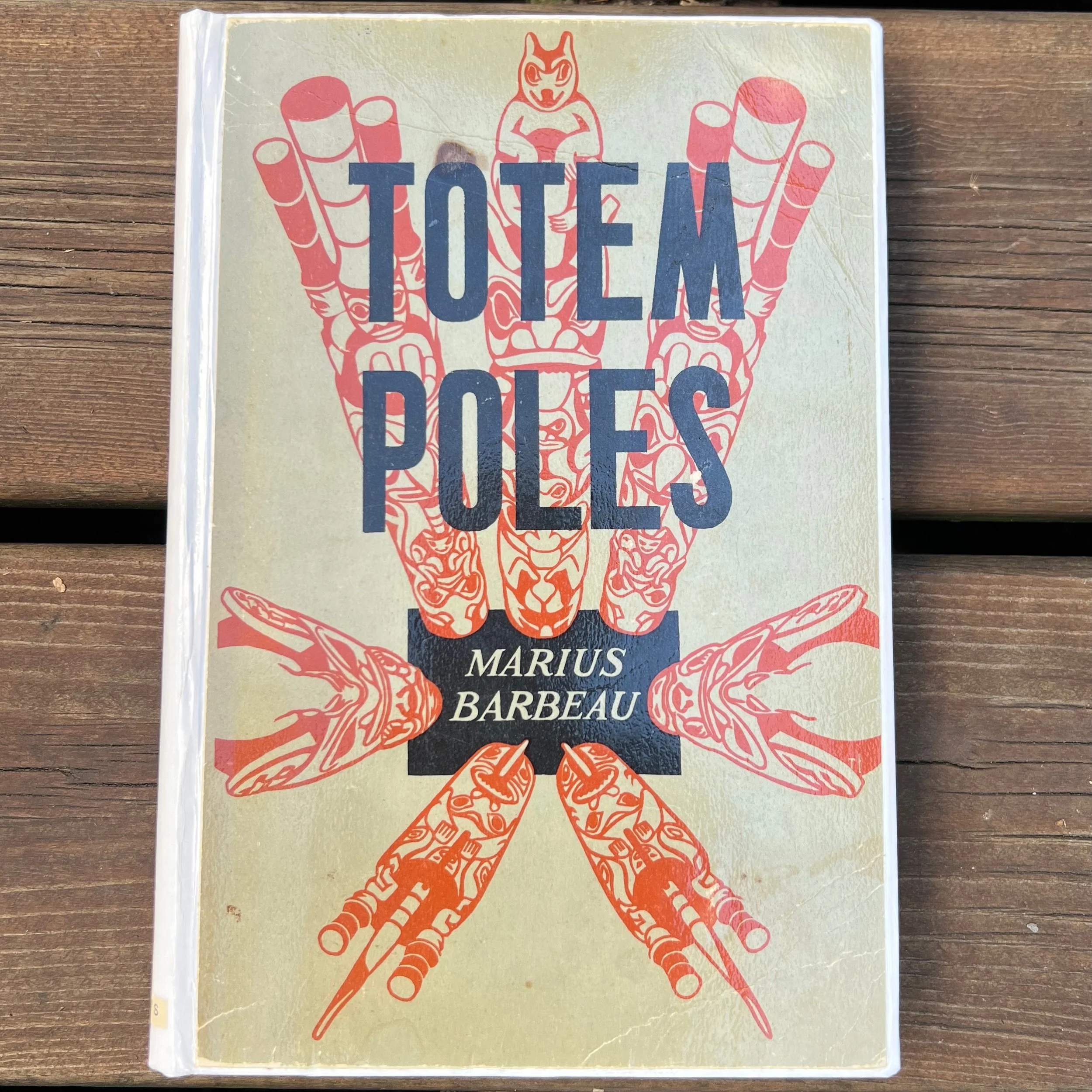
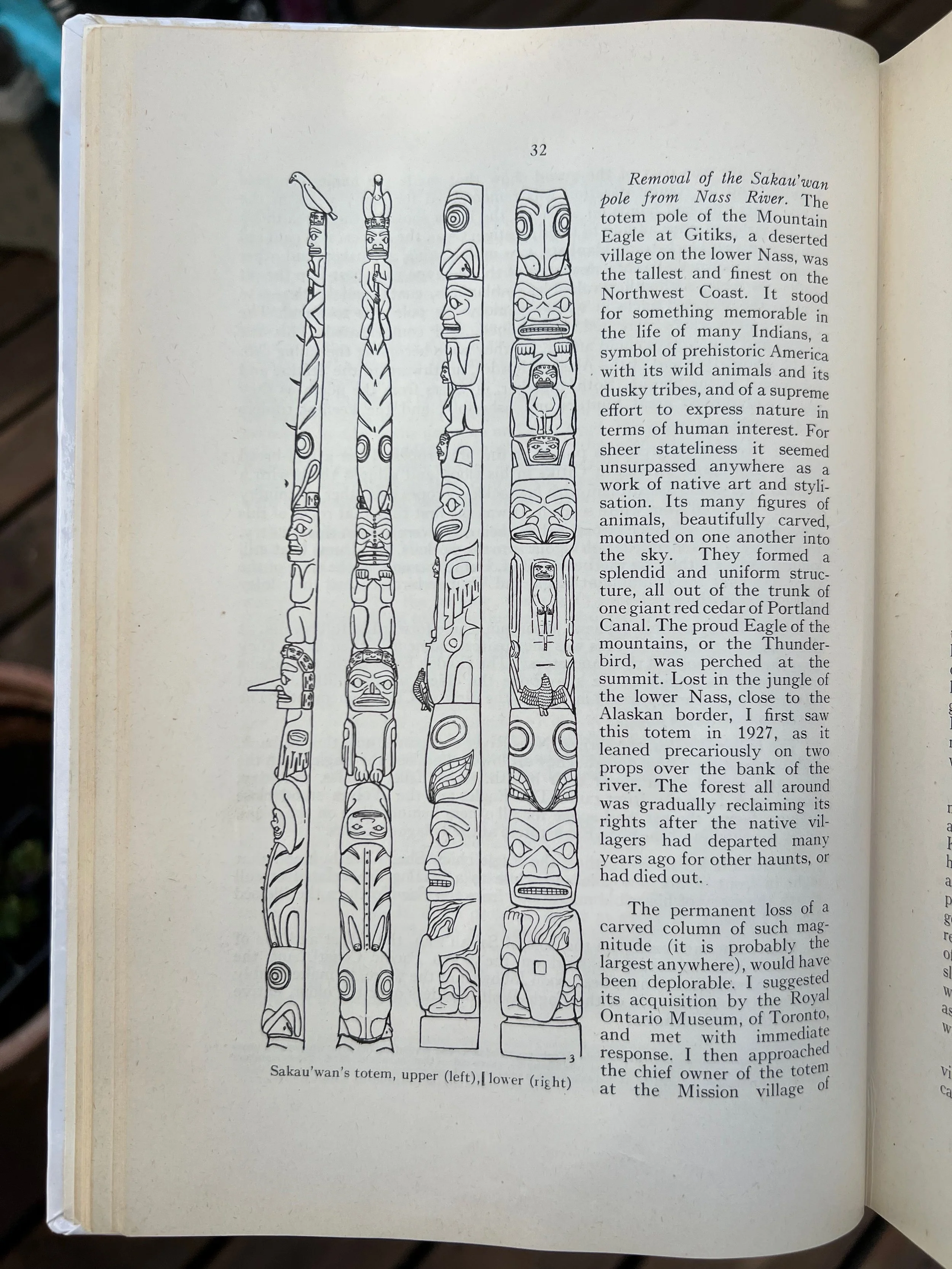
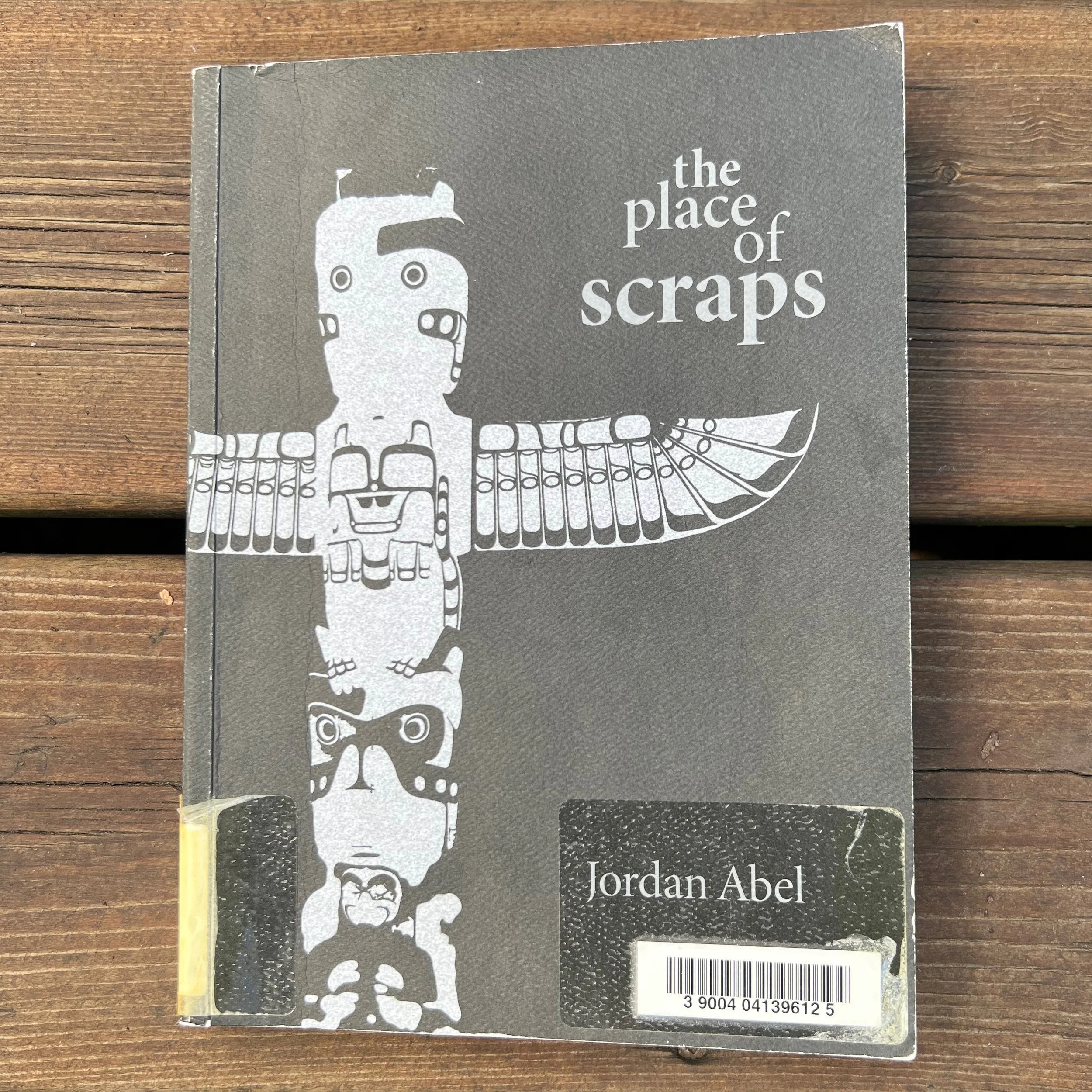
As for their physical displacement, here’s what Barbeau wrote about the journey of the tallest pole now in the ROM, from the village of Gitiks on the Nass River:
“The pole transported to Toronto. To remove this huge totem pole from the Nass, and transfer it to a museum thousands of miles away was not an easy job. Taking it down to the ground and shifting it into the water taxed the ingenuity of a railway engineer and his crew of Indians. It leaned sharply, face forwards, and had it fallen, its carvings would have been damaged. But the work was successfully carried out and after a few days the pole with two others was towed down Portland Canal, on its way south along the coast to Prince Rupert. As it floated in the water, several men could walk on it without feeling a tremor under their feet; it was so large that a few hundred pounds made no difference. When it reached Prince Rupert, it had to be cut, as it lay in the water, into three sections, for the longest railway cars are 50 feet. Nor were all difficulties overcome after the three sections had reached Toronto.”
And here’s what Nisga’a poet Jordan Abel makes of this passage in his book The Place of Scraps, leaving some of Barbeau’s words and removing others. He works painstakingly, maybe we could say forensically, but also I would suggest playfully, and ultimately devastatingly:
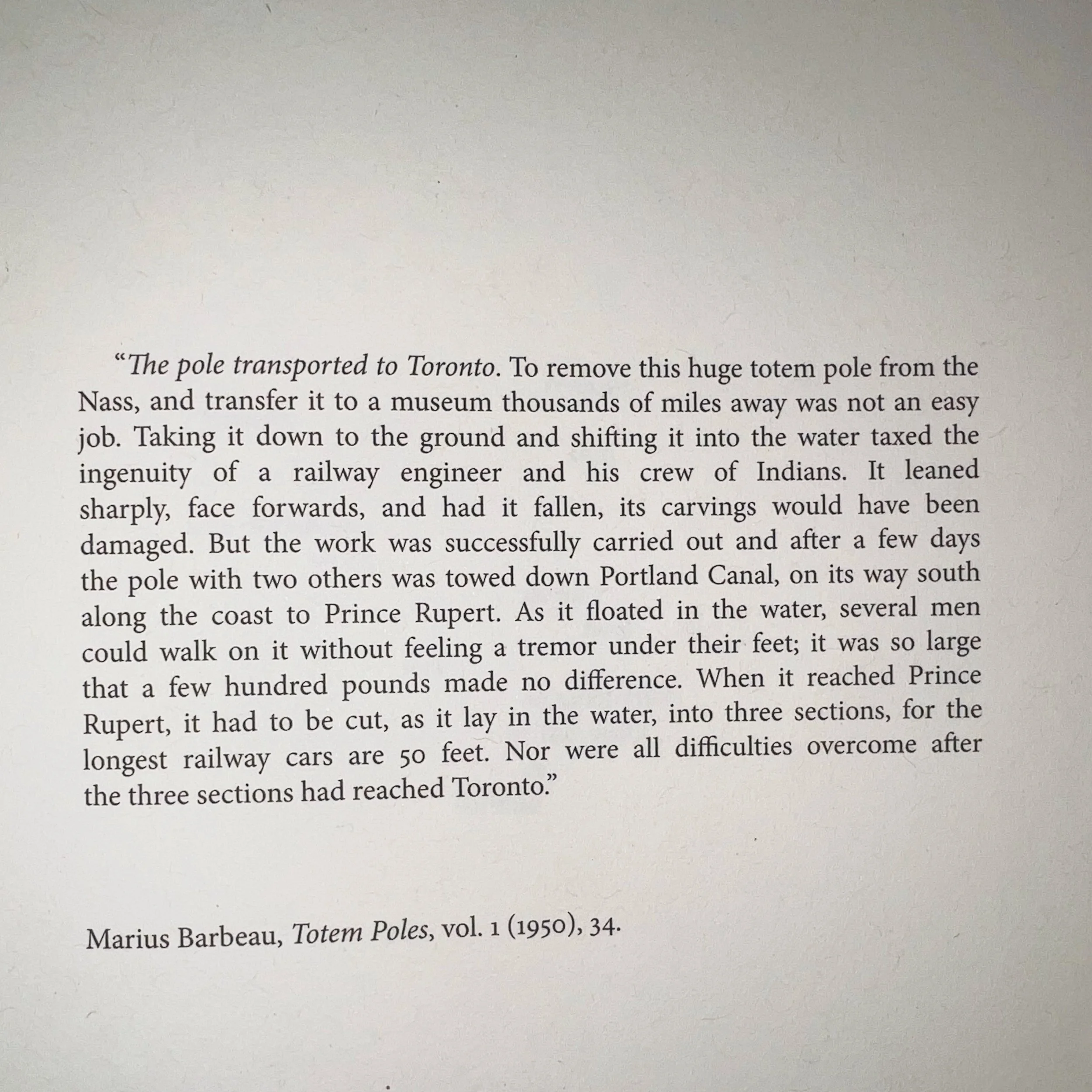
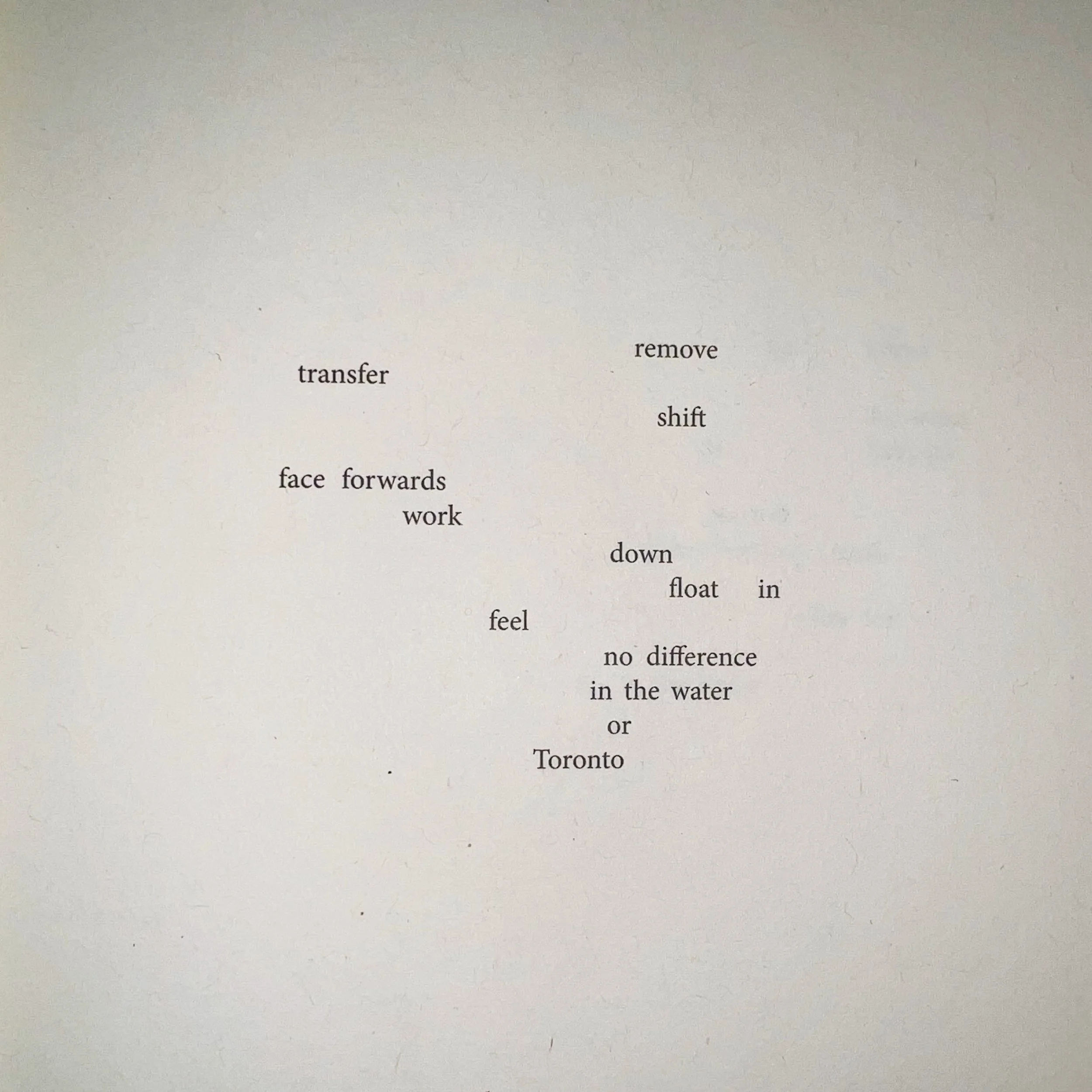
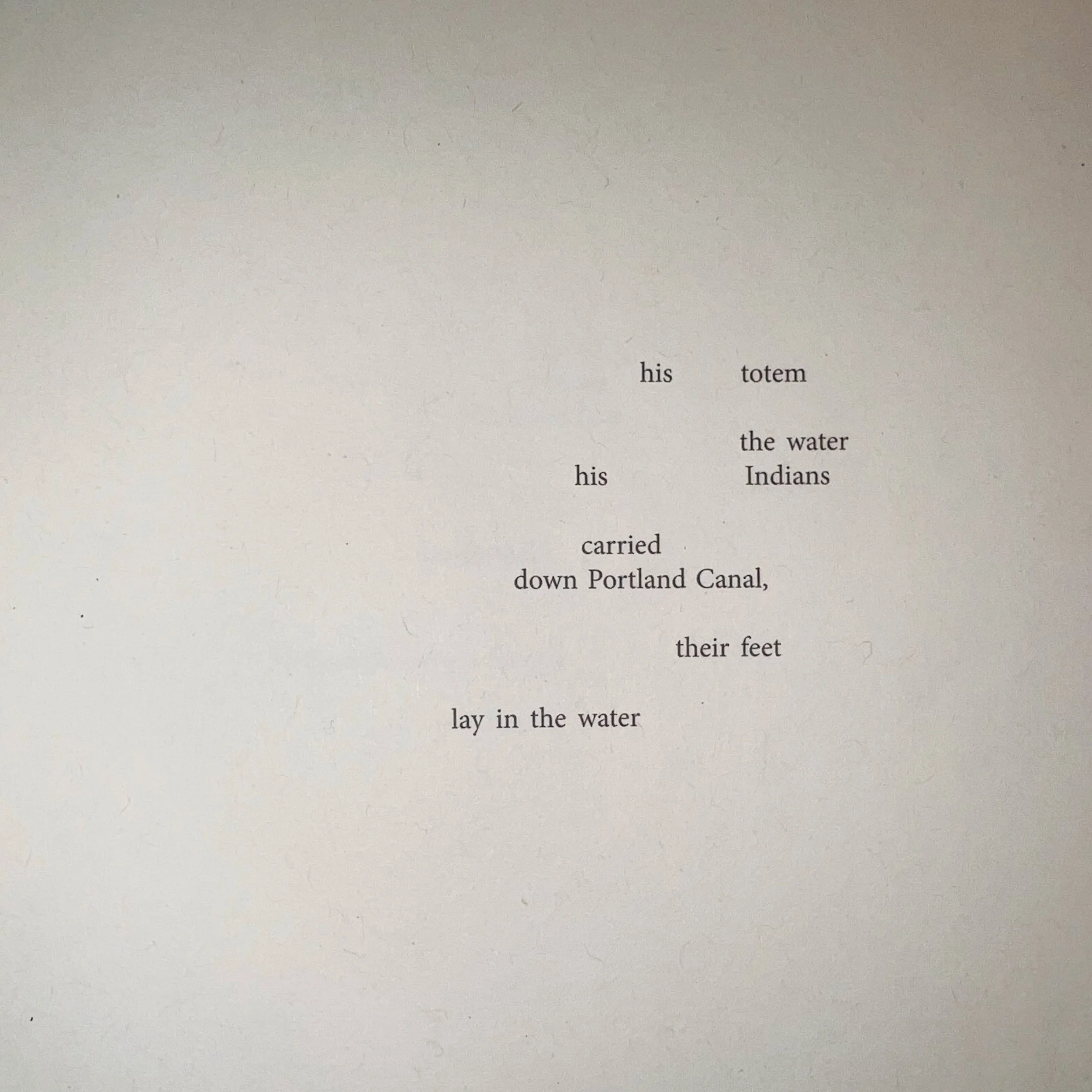
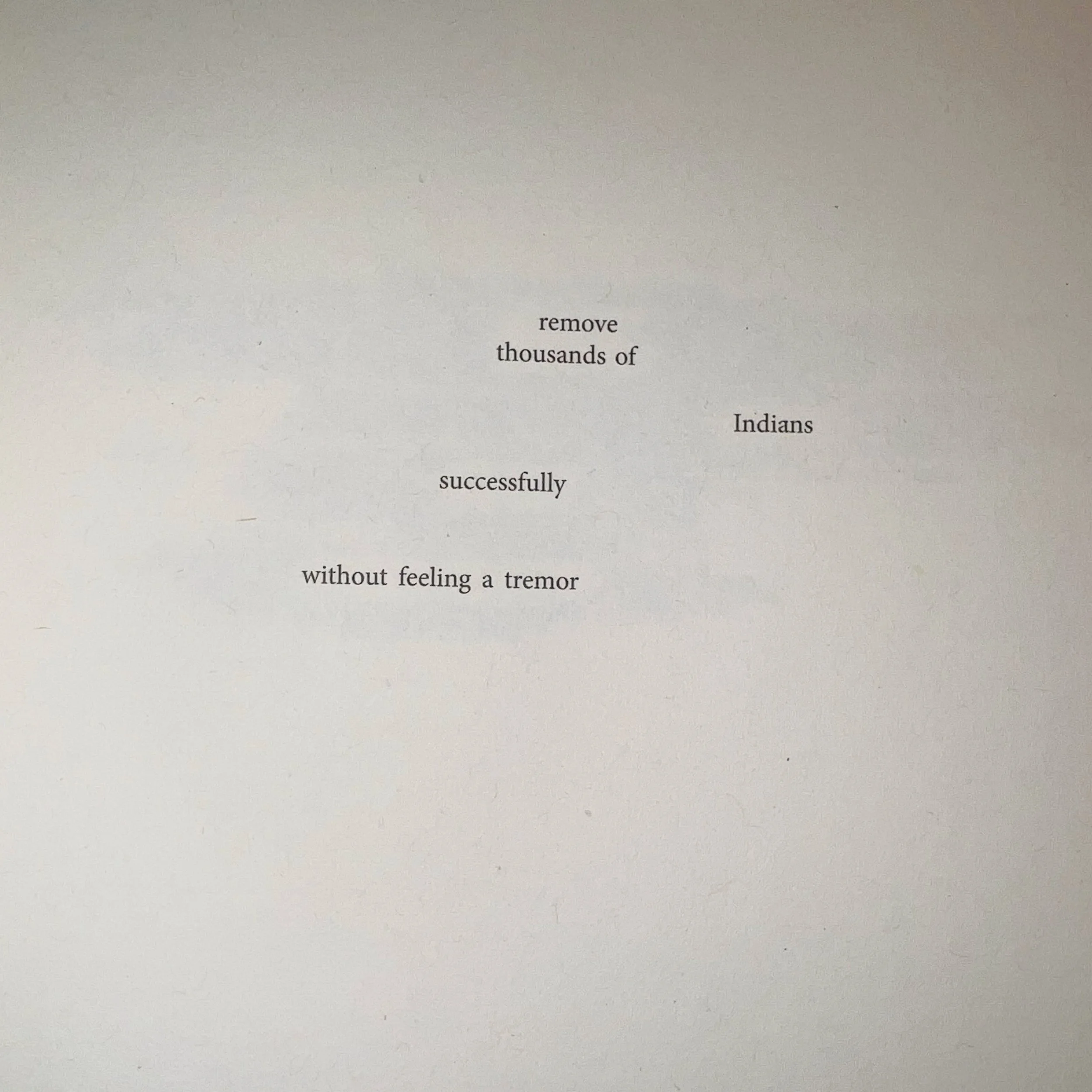
As some reviewers have said, Abel is himself a carver, treating Barbeau’s book like the wood from which it comes. With Barbeau’s words as his medium, he reveals the work’s political unconscious. He cuts material away to reveal shapes and meanings in relief.
We see and feel the space thus created: in the pages above, space for the experiences of community members recruited for the labour of moving the pole — and even space for the experience of the pole itself. Space to sit with arrogance and loss. Space to acknowledge the truths Barbeau himself did not perceive or make space for. The page almost vibrates.
The Place of Scraps rewards reading from beginning to end and back again, indeed in whatever directions you are drawn.
And as for the poles, Nisga’a people call them pts'aan; Haida people call them gyáaʼaang. They stand here, in the ROM, in the middle of these staircases. They hold their own.
— Laura Murray
References
Abel, Jordan. The Place of Scraps. Vancouver: Talonbooks, 2013.
Barbeau, Marius. Totem Poles. Ottawa: National Museum of Canada, 1950. (See pp. 21-35 for discussion of the Sakau’wan pole described above.)
Bohaker, Heidi. Doodem and Council Fire: Anishinaabe Governance Through Alliance. Toronto: The Osgoode Society/U Toronto P, 2020.
Jonaitis, Aldona, and Aaron Glass. The Totem Pole: An Intercultural History. Seattle/Vancouver: University of Washington Press and Douglas & McIntyre, 2010.
Schenck, Theresa M. “The Algonquian Totem and Totemism: A Distortion of the Semantic Field.” 341-353. David H. Pentland, ed., Papers of the Twenty-Eighth Algonquian Conference. Winnipeg: University of Manitoba, 1997.